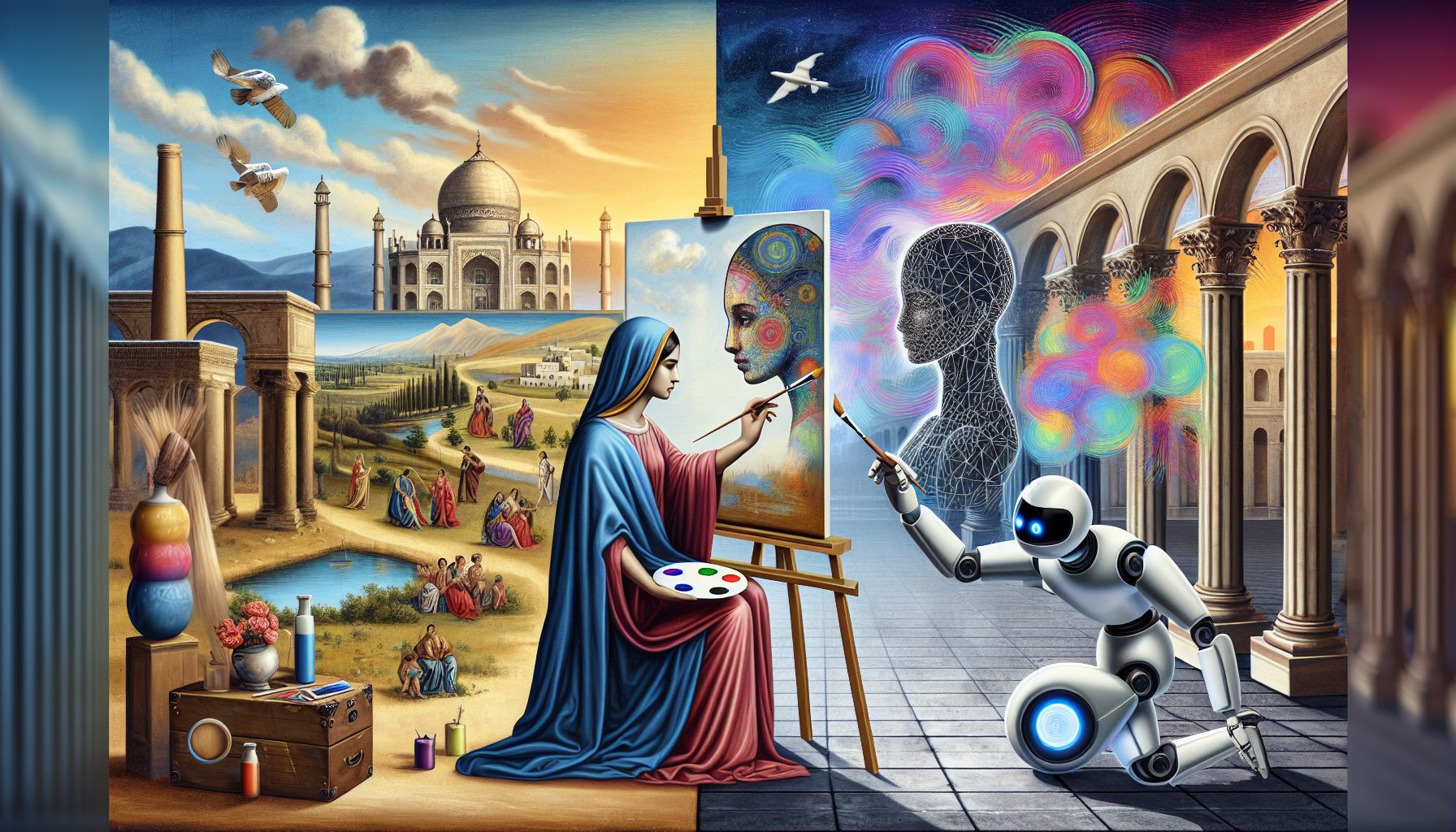
Hey fellow tech enthusiasts! If you’re anything like me, you probably wake up every morning wondering what mind-blowing technological marvel we’ll stumble upon next. Today, I’m geeked out about a topic that has blown my mind in ways I didn’t even know possible: Artificial Intelligence in the creative arts! Yep, you heard me right. Our silicon-based friends are not just crunching numbers or beating humans at chess anymore; they’re also penning poems, painting masterpieces, and even scoring symphonies. Grab a cup of coffee (or maybe a chai latte, hey, we like to keep things interesting), and let’s explore this brave new world.
The AI Picasso: Paintings Beyond Imagination
First up, let’s talk about AI-generated paintings. Remember when art was all about contemplating whether that abstract piece really captured the artist’s existential dread or just looked like someone accidentally dropped their sandwich on the canvas? Well, now we’ve got AI making art that’s as intriguing as it is innovative.
Companies like DeepArt and DALL-E 2 are pushing the boundaries of what we thought machines could achieve. AI models are learning from thousands of years of artistic mastery, from the wild brushstrokes of Van Gogh to the calculated geometry of Picasso. They’re even creating entirely new styles that are mesmerizing art critics and everyday Joes like you and me.
The kicker? These masterpieces don’t need to sleep, eat, or stare at a blank canvas pondering life’s big questions. They just create. Sure, they might not experience the human condition, but they offer fresh perspectives and tools for artists all around the world. I’m convinced we’re in the midst of a new Renaissance, an AI Renaissance, if you will.
Embracing the Musical Muse: AI Compositions
No discussion on AI in art would be complete without hitting the trends in music. Remember when folks were all up in arms about autotune? Well, AI takes technological musical enhancements to a whole new symphonic level.
Let me paint a little picture for you: Imagine an AI program listening to all of Bach’s compositions and then churning out a symphony that would leave even the stoic composer slack-jawed. Companies like OpenAI with its MuseNet and Jukedeck are training AI to understand musical theory and composition styles, creating original pieces from a huge library of influences.
Personally, I was skeptical at first. I mean, can a machine really capture the soul and emotion in music? But, surprise surprise, I found myself tearing up listening to an AI-composed piece. It made me think about all the indie musicians out there who can now remix, recompose, and collaborate with AI to refine and even redefine their personal sound.
Poetry in Motion: AI’s Literary Prowess
It’s not just about visual and auditory arts; AI is also stepping into the whimsical world of poetry. Odd, right? Poetry’s always seemed the domain of the angst-ridden artist scribbling away in dark cafes, mulling over the futility of life, or maybe that’s just how I picture it. Enter AI, effortlessly crafting verses in a way that makes you feel all the feels.
Tools like OpenAI’s GPT-3 can generate compelling poetry and prose, mimicking human emotions with uncanny accuracy. I’ve read some AI-generated poetry that utterly floored me. It makes you question what it means to be “creative” and whether creativity is solely the realm of humans, or if these digital beings can truly be considered co-creators.
The Critics Speak: Discussions and Dilemmas
For all the marvels AI is creating in the artistic space, there are definitely some raised eyebrows. Like, can something created by an algorithm have the same kind of intrinsic value as, say, a Monet? What about the notion of copyright and ownership, do the AI’s creators get the accolades, or is it the machine itself deserving of a standing ovation?
Moreover, not all artists are thrilled about this digital incursion in their domain. There’s a concern that AI might outshine human creativity, trivialize craftsmanship, or make art less accessible as a professional field. Still, many artists see AI as a new tool, like the invention of the camera was to painting, an opportunity to enhance human creativity.
The Future of AI in Creative Arts: Endless Possibilities
While we might not have all the answers about AI’s role in the art world, one thing’s certain, it’s not going away. If anything, it’s just getting started. Personally, I see AI as an incredible ally to human creativity, a Baxter to our Sherlock if you will. It offers up endless possibilities to explore and express ourselves in ways we’ve only dreamed of.
The fusion of AI and the arts is an exciting, changing field. It challenges us to redefine what it means to be creative and how we interpret beauty and expression. Whether it’s composing a memorable sonata, writing a game-changing novel, or painting the next Mona Lisa, AI is leading us into an uncharted artistic universe.
Keep your eyes peeled, folks. The AI Renaissance is upon us, and who knows, you might just come across an AI creation that stirs your soul or even inspires your next creative venture.
Cheers to the fusion of innovation and imagination!